

CHRISTOPHER WOOL: UNTITLED, 2018
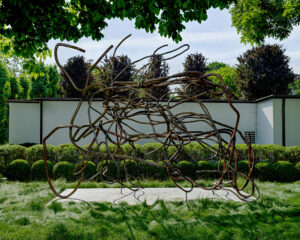
Christopher Wool, Untitled, 2018.
Bronze and copper-plated steel.
144 x 193 1/2 x 102 1/4 inches (365.8 x 491.5 x 259.7 cm).
© Christopher Wool.
Photo: Maris Hutchinson.
Image courtesy the artist
Christopher Wool is known for stark text paintings and materially dense abstractions that probe repetition, erasure, and the mechanics of image-making. His practice includes painting, photography, bookmaking, works on paper, mosaic, and sculpture, with each medium connected through a distinct vocabulary of imagery, gesture, and mark-making. Living and working between New York and Marfa, Texas, Wool’s work is shaped by the contrasting visual environments of the urban landscape and the expansive West Texas desert, where layers of accumulation, absence, and found materials inform his approach across media. In recent years, he has translated this language into large-scale sculptures—monumental forms derived from his looping line work and digital processes, referencing found ranching wire and other elements of Marfa’s built environment.
Located on the East End of Long Island, a region with a significant history of American abstraction, Guild Hall provides a particularly meaningful setting for the presentation of Wool’s Untitled, 2018 bronze and copper-plated steel sculpture. At Guild Hall, the work engages with the architecture and landscape, balancing monumentality with sensitivity to the environment it occupies. Its relationship to the trees, shifting shadows, and the building’s mechanical elements—including its metal piping—reveals a dialogue between structure, nature, and Wool’s ongoing exploration of form, surface, and space.
In addition to numerous international exhibitions, Wool has been the subject of major solo exhibitions at the Solomon R. Guggenheim Museum, the Art Institute of Chicago, the Museum of Contemporary Art, Los Angeles, and the Carnegie Museum of Art, affirming his position as one of the most influential American artists of his generation. See Stop Run, an ambitious survey of Wool’s recent works organized in 2024 by the artist with curator Anne Pontégnie, occupied an entire floor of a space in New York’s Financial District. A second part of the exhibition, complemented by three large outdoor sculptures, opened at the Brite Building in Marfa, Texas, in 2025, where it will remain on view for two years.
TONY ROSENTHAL: CUBE 72
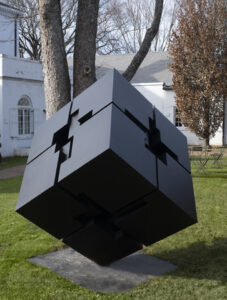
Tony Rosenthal
Cube 72, 2024
Painted Cor-Ten steel
7’ High on 4’ x 4’ base
Guild Hall permanent collection, gift of the artist.
For more than 50 years, Alamo, Tony Rosenthal’s 15-foot-tall Cor-Ten steel sculpture that pivots on its axis, has been as much as part of its Astor Place neighborhood in Lower Manhattan as the Cooper Union. Rosenthal’s Cube 72, a 90-inch-square, or half-size version of Alamo, was given by the artist to Guild Hall and installed in front of the building in 1972, the same year the artist moved to Springs with his first wife, Halina Kolowicz. Cube 72 was re-installed in the front of Guild Hall in November 2023, thanks in large part to the efforts of Dave Petrie, the C.E.O. of Tony Rosenthal Art, and is now located in the Furman Garden.
Tony Rosenthal (1914-2009), was one of the many artists who made a home on the East End. He was born in Highland Park, Illinois, in 1914, and got his first taste of creating art out of inanimate objects when, at nine years old, he was enrolled by his mother in a basic carving sculpture course for kids at the Art Institute of Chicago. His first work was in soap; by the 1930s, he was working in full-on bronze as a studio assistant to master sculptor Alexander Archipenko.
Perhaps is was during this time and the following years, when President Roosevelt’s Work Progress Administration was supporting art for all as the order of the day, that Rosenthal gained his love for sculpture that would become part of community life — the very same concept that spawned Guild Hall back in 1931, when East Hampton resident Mary Woodhouse funded the creation of one of the country’s first interdisciplinary, community-focused art centers.
Rosenthal, who passed away in Southampton in 2009 at the age of 94, was known for saying that he enjoyed making public sculptures for participation; objects with a functional purpose as well as an aesthetic one. Back where it belongs, the public is encouraged to come by and take it for a “spin.”
PETER DAYTON: DARK GARDEN
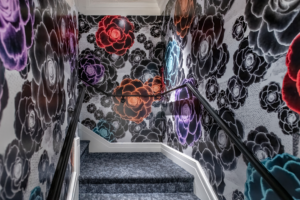
Peter Dayton
Dark Garden, 2024
Ink on premium vinyl with
low-luster laminate and collage overlay
After a nearly decade-long career as a punk rock musician, Peter Dayton returned to visual art upon moving to East Hampton in the mid-1980s. Dark Garden is a site-specific installation created for Guild Hall’s stairwell leading from the lobby to the balcony of the Hilarie and Mitchell Morgan Theater. Dayton’s exploration of flowers began when he found discarded issues of House and Garden magazine from the 1950s near his home, and his collages utilize photocopied flowers from seed catalogs, which links his practice to the work of Andy Warhol and other pop artists. He chooses visually arresting images of flowers without leaves and stems—images devoid of sentiment, emotion, or specific references—allowing the flower forms to create their own patterns.
Peter Dayton (b. 1955, New York) attended art schools in Europe in the 1970s and graduated in 1979 from the School of the Museum of Fine Arts in Boston, where he studied visual, video, and performance art. Initially he pursued music as an art project, then became a professional musician, first in the punk rock band La Peste, then under his own name until 1986. He turned his attention back to visual art in 1988. Dayton’s work often references various art historical movements and concepts such as minimalism, pop art, abstract expressionism, and feminism. He simultaneously explores and critiques commodity culture and art historical movements through varied materials, techniques, and presentations.
Dayton has participated in solo and group exhibitions nationally, internationally, and extensively on the East End of Long Island. He has produced numerous site-specific installations and commissions for Louis Vuitton, Chanel, the Peter Marino Art Foundation, and the Museum of Fine Arts, Houston, to name a few. This is his first project for Guild Hall.
Dayton lives and works in East Hampton, New York.
JOEL MESLER: WATER IMMERSION
Joel Mesler
Water Immersion, 2024
Non-woven velum mural
147 x 333 ¼ inches per roll
The wallpaper displayed in the Pantzer Gallery is adapted from one of Joel Mesler’s paintings of pool reflections, a recurring motif in his work that he uses to reference childhood memories of joy and innocence set against the trauma that shaped his upbringing in 1980s Los Angeles. This installation is one of three wallpaper patterns Mesler has recreated from his paintings, including Heart Vine Leaf (2025) and Martinique® (2024).
Mesler’s practice filters autobiography through humor, vulnerability, and bold visual language. His use of graphic patterns, expressive typography, and personal iconography explores acceptance and the emotional weight carried by cultural symbols. In 2025, Guild Hall staged Joel Mesler: Miles of Smiles, the artist’s first U.S. museum exhibition and his first presentation in the region he has called home since 2017.
Visual Arts programs are supported by Principal Sponsors Lucio and Joan Noto, with additional support provided by The Giuppy Nantista Fund, The Hoie Fund, The Melville Straus Family Endowment, The Michael Lynne Museum Endowment, and Vital Projects Fund.
Additional support provided by Friends of the Museum: Danielle Mandelbaum Anderman, Shari and Jeff Aronson, The Artist Profile Archive, William L. Bernhard, Elizabeth Gordon and Woody Heller, The Hayden Family Foundation, Robert Longo and Sophie Chahinian, Elin and Michael Nierenberg, Onna House, Lori and John Reinsberg, Jeff and Audrey Spiegel, Hillary and Jeff Suchman, Jane Wesman and Don Savelson, and Yurman Family Foundation.