

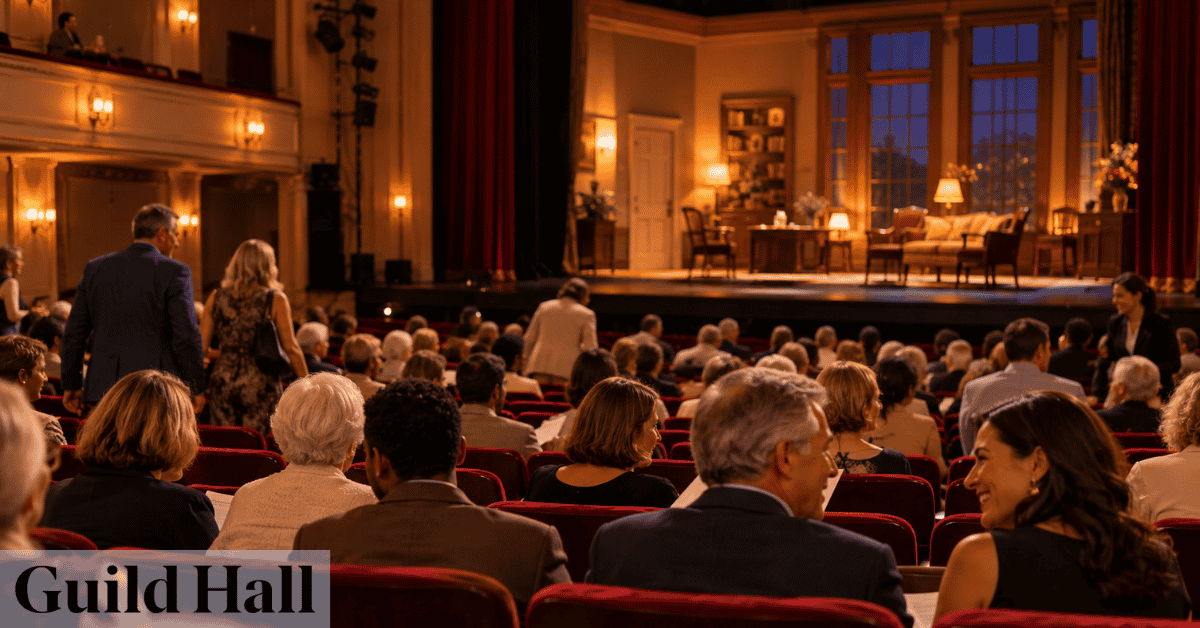
Whether you’re visiting East Hampton or discovering live theater for the first time, knowing a few practical details can make the evening easier.
This guide covers everything from choosing a performance and finding your seat to understanding theater etiquette.
What to Expect at Your First Live Theater Performance
You don’t need to know theatrical terminology, recognize the cast, or study the story beforehand to enjoy your first performance. A little curiosity is enough to get started.
At a typical live theater performance, you can expect:
- A scheduled start time and an assigned or designated seating arrangement, depending on the event.
- Performers presenting a story or artistic work before an audience.
- Lighting, sound, costumes, movement, or scenery that help shape the experience.
- Moments when the audience reacts through laughter, applause, or silence.
- A conclusion that may be followed by applause, a curtain call, or, for selected programs, a discussion.
Not every performance follows the same structure. Some productions use elaborate staging, while others rely on a small cast, minimal scenery, or a script reading.
For visitors interested in the broader regional theater scene, Guild Hall’s article on live theater on Long Island’s East End provides additional cultural context.
How Live Theater Differs From Watching a Movie
One of the biggest differences between theater and film is immediacy.
A movie is recorded, edited, and presented as a finished work. A live theatrical performance unfolds in front of you, with actors responding to one another in real time.
This changes the relationship between performers and audiences.
When an actor delivers an emotional line, the audience experiences that moment directly. When a scene becomes funny, laughter spreads through the room. When something unexpected happens, everyone present shares the same experience.
Live theater also asks audiences to use their imagination.
A simple stage setting might represent an entire city. A change in lighting may suggest a different time of day. A few objects might become the foundation of a much larger fictional world.
You do not need elaborate visual effects to become involved in the story. Often, the combination of performance, language, movement, and imagination is enough.
For those curious about the broader role of live performance in American culture, the National Endowment for the Arts offers research and resources exploring how the performing arts contribute to cultural life and public engagement.
Choosing the Right Theater Performance for Your First Visit
Choosing a performance that matches your interests can make your first theater experience more enjoyable.
Start with the description of the event rather than assuming that every theatrical production offers the same experience.
Some performances focus on dramatic storytelling. Others emphasize comedy, movement, music, experimental techniques, or audience interaction.
Consider what appeals to you.
For storytelling enthusiasts: A traditional play or contemporary dramatic production may be a good starting point.
For audiences who enjoy humor: A comedy or performance with comedic elements may offer a familiar entry into live theater.
For people interested in acting and writing: A staged reading can reveal how performers bring dialogue and characters to life.
For adventurous audiences: Experimental productions may combine theater with movement, sound, improvisation, or other artistic disciplines.
Guild Hall’s theater events calendar is a practical place to explore scheduled theatrical programs.
Visitors who are still deciding between different forms of cultural entertainment can also read How to Choose a Cultural Event in East Hampton.
Understanding Different Types of Theater Experiences
Not every theater event is a fully staged play.
Knowing the differences can help first-time visitors choose a performance that meets their expectations.
Fully Staged Productions
A fully staged play generally includes actors performing characters within a theatrical production. Depending on the work, it may incorporate costumes, scenery, lighting, sound, and choreographed movement.
These elements help establish the world of the story.
Staged Readings
A staged reading typically emphasizes the script and the performers’ interpretation of the text.
Actors may perform with scripts in hand, while scenery, costumes, and movement are often limited.
This format allows audiences to concentrate on dialogue, character relationships, and the structure of the writing.
Experimental and Contemporary Theater
Some performances challenge traditional storytelling.
They may combine spoken language, movement, improvisation, multimedia elements, or unconventional staging.
These experiences can be especially engaging for visitors interested in discovering new approaches to performance.
Screened Theater Productions
Some theaters also present filmed performances of stage productions.
These screenings allow audiences to experience acclaimed theatrical works on screen, but they are different from performances with actors physically present onstage.
For example, Guild Hall’s programming may include National Theatre Live presentations. Visitors should check individual event descriptions to understand whether they are attending a live performance or a screening.
The distinction is important when planning your first theater outing.
When to Arrive for a Theater Performance
Arriving with enough time to settle in can make the experience more comfortable.
First-time visitors should avoid planning to enter the building at the exact moment a performance begins.
Instead, allow time to:
- Find parking or complete your journey.
- Locate the correct entrance.
- Check tickets and event information.
- Find your seat.
- Visit the restroom if needed.
- Become familiar with the theater environment.
Arrival and late-seating policies vary by production. Check your Guild Hall ticket confirmation for event-specific instructions, and allow enough time to be seated before the performance begins.
Guild Hall provides information about parking, transportation, and visitor policies on its Plan Your Visit page.
What Should You Wear to a Live Theater Performance?
One of the most common questions for first-time theatergoers is whether they need to dress formally.
The answer depends on the venue, event, and occasion.
Some theater performances attract audiences wearing elegant evening attire. Others have a relaxed atmosphere where casual but comfortable clothing is common.
For most cultural outings, neat, comfortable clothing is a practical choice unless the event specifies a dress code.
Consider the season, travel conditions, and how long you will be seated.
You do not need to dress like a regular theater patron to belong in the audience. The purpose of attending is to experience the performance.
Theater Etiquette for First-Time Visitors
Understanding a few basic theater etiquette principles can help you feel more confident.
Most expectations are simply about respecting performers and the people around you.
Silence Your Phone
Before the performance begins, silence your phone and put it away.
A bright screen, notification, or ringtone can interrupt an important moment for both performers and audience members.
Avoid Talking During the Performance
It is natural to want to react to what you see.
However, conversations should generally wait until a suitable break or the end of the performance.
Laughter and other spontaneous reactions are part of live theater, but ongoing conversation can distract nearby guests.
Follow Photography and Recording Rules
Do not assume that photography or video recording is permitted during a theatrical performance.
Rules can vary by production, even within the same venue.
Always follow the instructions provided by theater staff or event organizers.
Be Considerate When Entering or Leaving
If you need to leave your seat during a performance, try to minimize disruption.
Some productions may have specific policies for late arrivals or reentry. Follow staff guidance rather than assuming that you can enter or return at any moment.
Know When to Applaud
For most performances, applause at the end is appropriate.
During the production, audience reactions may vary depending on the format and atmosphere.
If you are unsure, following the audience’s lead is perfectly reasonable.
Good theater etiquette is not about knowing unwritten rules. It is about helping everyone share the experience comfortably.
How to Enjoy Theater Without Knowing Much About Acting or Drama
Start with the characters and the story. Notice how an actor’s voice changes during an emotional scene, how lighting creates atmosphere, or how a pause can communicate something that words leave unsaid.
You might ask yourself:
- What is each character trying to achieve?
- How does the atmosphere change throughout the performance?
- Which moment captures my attention most strongly?
- How do the actors communicate emotions without explaining everything?
- What questions does the story leave me thinking about?
You do not have to analyze every scene.
Sometimes the most enjoyable approach is simply to follow the story and allow yourself to respond naturally.
For a deeper look at how theatrical work develops, Guild Hall’s article on the creative process in performing arts in the Hamptons offers a complementary perspective.
What Happens During Intermission and After the Performance?
Some theatrical productions include an intermission, while others run without a break.
When an intermission is scheduled, audience members generally have time to stretch, use the restroom, or take a short break before returning to their seats.
Check the event information rather than assuming every performance includes one.
At the end of a live production, audiences typically applaud the performers. Some events include a curtain call, while others may transition into a discussion or additional program.
Selected theatrical presentations also feature post-performance conversations, often called talkbacks.
These discussions may involve performers, directors, writers, or other creative participants and can provide insight into the work.
Visitors interested in the conversational side of cultural events may enjoy Guild Hall’s guide on what to expect at an artist talk.
Experiencing Theater at Guild Hall in East Hampton
Guild Hall has a longstanding connection to the performing arts on Long Island’s East End.
Its Hilarie and Mitchell Morgan Theater, historically known as the John Drew Theater, has been part of East Hampton’s cultural landscape since 1931.
The theater has welcomed established performers, emerging artists, theatrical productions, staged readings, dance, music, comedy, and public programs.
Its programming reflects the idea that live performance can take many forms.
For someone attending their first theatrical event, Guild Hall provides an opportunity to experience performance within a cultural institution that also connects audiences with exhibitions, education, and community programming.
Visitors can explore Performing Arts at Guild Hall to learn more about its history and programming.
Guild Hall’s article on Long Island Theater also provides useful background on the institution’s role in the region’s theatrical culture.
Accessibility and Comfort for First-Time Theatergoers
A first theater experience should feel welcoming.
Visitors who have questions about mobility, seating, accessibility, or other practical needs should review available information before purchasing tickets.
Guild Hall provides wheelchair-accessible public entrances, accessible theater seating, designated accessible parking spaces, and wheelchair-accessible public restrooms.
Visitors needing wheelchair seating are encouraged to select accessible seats during online ticket purchase or request them when booking.
Additional information is available through Guild Hall’s official accessibility guide.
Readers can also explore the article on accessible arts in East Hampton Village for a broader look at cultural accessibility.
Checking these details beforehand can help visitors concentrate on the performance rather than logistical concerns.
Planning Your First Theater Visit to Guild Hall
Guild Hall is located in East Hampton Village, making it accessible to residents and visitors exploring the cultural life of Long Island’s East End.
Guild Hall is located at:
Before attending, review your event’s start time, ticket details, accessibility information, arrival instructions, and estimated duration.
Guild Hall’s official visitor information identifies parking behind the building on Pondview Lane, as well as parking options along Main Street and James Lane. Visitors should allow sufficient time to find parking when attending programs.
Make Your First Live Theater Experience a Memorable One
Your first theater visit does not need to feel complicated.
Choose a performance that interests you, review the details beforehand, arrive with enough time to settle in, and allow yourself to experience the story as it unfolds.
Live theater offers something that cannot be fully recreated on a screen: performers and audiences sharing the same moment.
At Guild Hall in East Hampton, first-time visitors can discover a wide range of performing arts experiences in a historic cultural setting.
Explore upcoming theater events, discover Performing Arts at Guild Hall, or plan your first visit to enjoy a cultural experience on Long Island’s East End.