

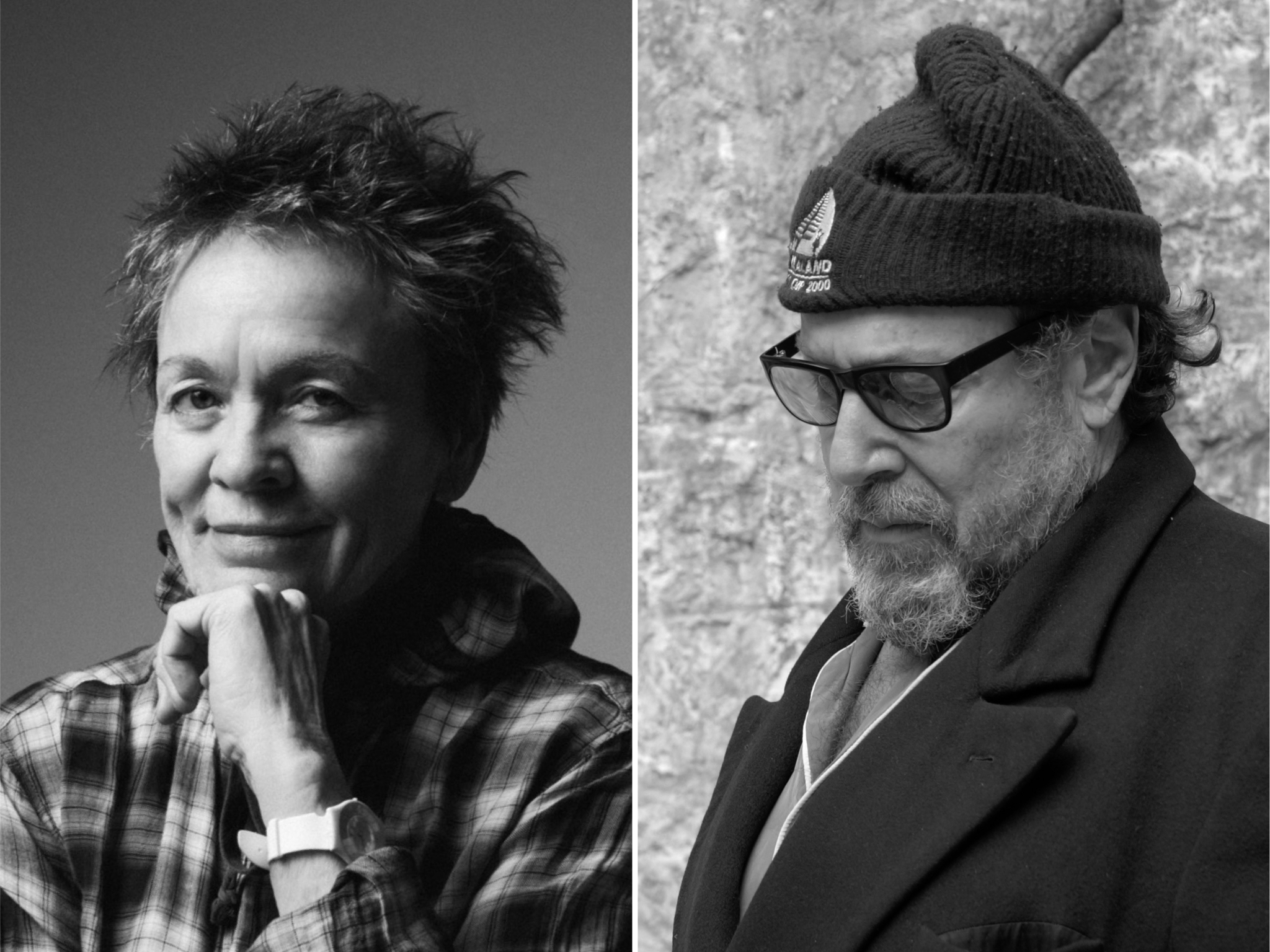

Join us for a very special intimate conversation between world renowned artists and good friends Laurie Anderson and Julian Schnabel. These multi-talented artists and Guild Hall Lifetime Achievement in the Visual Arts award winners will discuss life, art, friends and folly.
Run time: Approx 1 hour
THIS PROGRAM WILL NOW TAKE PLACE INDOORS IN THE JOHN DREW THEATER. Guests attending any INDOOR John Drew Theater programs must show proof of FULL vaccination. At this time, only fully vaccinated guests are permitted to attend programs in the indoor theater. Face coverings are now optional for fully vaccinated guests.
Click HERE for full COVID-19 information to review prior to your visit.
Laurie Anderson, 2018. Photo: EbruYildiz
Julian Schnabel, Paris 2016. Photo: Louise Kugelberg
Laurie Anderson
Laurie Anderson is one of America’s most renowned—and daring—creative pioneers. Her work, which encompasses music, visual art, poetry, film, and photography, has challenged and delighted audiences around the world for more than forty years. In a recent "60 Minutes" profile, Anderson Cooper said she “is a pioneer of the avant-garde, but ... that doesn’t begin to describe what she creates. Her work isn’t sold in galleries. It’s experienced by audiences who come to see her perform: singing, telling stories, and playing strange violins of her own invention ... she [blends] the beautiful and the bizarre, challenging audiences with homilies and humor. She blurs boundaries across music, theater, dance, and film.” The Washington Post has said she “doesn’t just tell stories; she draws out every word with a kind of physical pleasure, tasting its flavor as she probes the everyday mysteries of life,” and the Guardian has called Anderson “one of the great popular artists and storytellers of our time.”
Anderson released her first album with Nonesuch Records in 2001, the critically lauded Life on a String. Her subsequent releases on the label include Live in New York (2002), Homeland (2010), the soundtrack to Anderson’s acclaimed film Heart of a Dog (2015), and her Grammy-winning collaboration with Kronos Quartet, Landfall (2018). Additionally, Anderson’s virtual-reality film La Camera Insabbiata, with Hsin-Chien Huang, won the 2017 Venice Film Festival Award for Best VR Experience, and, in 2018, Skira Rizzoli published her book All the Things I Lost in the Flood: Essays on Pictures, Language and Code, the most comprehensive collection of her artwork to date.
Recent exhibitions and installations of Anderson’s work include Habeas Corpus at New York’s Park Avenue Armory; her largest exhibition to date, The Weather, at Washington, DC’s Smithsonian’s Hirshhorn Museum of Modern Art; and Looking into a Mirror Sideways at Stockholm’s Moderna Museet, which was her largest European exhibition to date. Anderson recently toured with Sex Mob, performing her piece Let X=X. Earlier this year, she was awarded the 2024 Stephen Hawking Medal for Science Communication, along with Christopher Nolan and David Attenborough, and the International Astronomical Union named a minor planet in her honor: Asteroid 270588.
Photo: Ebru Yildiz
Julian Schnabel
Julian Schnabel was born in New York City in 1951. In 1965, he moved with his family to Brownsville, Texas. He attended the University of Houston from 1969-73, receiving a BFA, and returned to New York to participate in the Whitney Museum Independent Study Program. In 1976-77, Schnabel traveled throughout Europe. He returned in 1978 and while in Barcelona was particularly moved by the architecture of Antoni Gaudí. That same year he made his first plate painting, The Patients and the Doctors.
Schnabel's work defies traditional categorization, culling distinct sources and disparate media engaging in material experimentation, negotiating the physicality of surface, and exploring the relationship between figuration and abstraction, the contradiction between the pictorial and the physical. His practice has always embraced unconventional methods– from employing velvet as his canvas, to layering shattered shards of ceramic onto wooden supports – to explore the physical potentials of the pictorial surface in a non-hierarchical, Whitmanesque manner, drawn from personal narratives that span history and mythology while reflecting the artist’s interest in philosophy and contemporary thought and humor.
Schnabel’s paintings, sculptures, and works on paper have been the subject of numerous solo exhibitions around the world: Kuntsthalle, Basel, 1981; Stedelijk Museum, Amsterdam, 1982; Tate Gallery, London, 1982; Whitechapel Gallery, London, 1987; Kunsthalle Düsseldorf, Düsseldorf, 1987; Centre Georges Pompidou, Paris, 1987; Whitney Museum of American Art, New York, 1987; San Francisco Museum of Modern Art, San Francisco, 1987; Museum of Fine Arts, Houston, 1987; Cuartel del Carmen, Seville, 1988; Musée d’Art Contemporain, Nîmes, 1989; Staatliche Graphische Sammlung, Munich, 1989; Palais des Beaux-Arts, Brussels, 1989; Fruitmarket Gallery, Edinburgh, 1989; Museum of Contemporary Art, Chicago, 1989; CAPC Musee D’Art Contemporain, Bordeaux, 1989; Museo de Arte Contemporáneo, Monterrey, 1994; Fundació Joan Miró, Barcelona, 1995; Museo Tamayo, Mexico City, 1995; Galleria d’Arte Moderna di Bologna, Bologna, 1996; Schirn Kunsthalle, Frankfurt, 2004; Museo Nacional Centro de Arte Reina Sofía, Palacio Velázquez, Madrid, 2004; Tabakalera, San Sebastián, 2007; Museum Kiasma, Helsinki, 2008; Museo di Capodimonte, Naples, 2009; The Art Gallery of Ontario, Toronto, 2010; Museo Correr, Piazza San Marco, Venice, 2011; The Brant Foundation Art Study Center, Greenwich, 2013; Dallas Contemporary, Dallas, 2014; Museu de Arte de São Paulo, São Paulo, 2014; NSU Art Museum Fort Lauderdale, Fort Lauderdale, 2014; Aspen Art Museum, Aspen, 2016; Legion of Honor Museum, Fine Arts Museums of San Francisco, 2018; Musée d’Orsay, Paris, 2018; CAC Malaga, Malaga, 2022; Guild Hall, East Hampton, 2024; and Château La Coste, Le Puy-Sainte-Réparade, 2026.
In 1995, Schnabel wrote and directed the feature film Basquiat about fellow New York artist Jean-Michel Basquiat. The film was in the official selection of the 1996 Venice Film Festival. Schnabel’s second film, Before Night Falls, based on the life of the late exiled Cuban novelist Reinaldo Arenas, won at the 2000 Venice Film Festival both the Grand Jury Prize and the Coppa Volpi for best actor, Javier Bardem, who was also nominated for Best Actor at the Academy Awards that year. In 2007, Schnabel directed his third film, The Diving Bell and the Butterfly. Schnabel received the award for Best Director at the Cannes Film Festival as well as Best Director at the Golden Globe Awards, where the film won Best Film in a Foreign Language. The Diving Bell and the Butterfly was nominated for four Oscars including Best Director. That same year he made a film of Lou Reed’s Berlin concert at St. Ann’s Warehouse in Brooklyn. In 2010 Schnabel’s film Miral premiered at the General Assembly Hall of the United Nations. Miral won the UNESCO as well as the UNICEF award at the 2010 Venice Film Festival. At Eternity’s Gate premiered at the 2018 Venice Film Festival, where Willem Dafoe won the Volpi Cup for Best Actor for his portrayal of Vincent Van Gogh. Dafoe was then nominated for Best Actor at both the Golden Globes and the Academy Awards. Schnabel’s latest film In the Hand of Dante – starring Oscar Isaac, Gal Gadot, Gerard Butler, John Malkovich, Al Pacino, Martin Scorsese and Jason Momoa – premiered at the 2025 Venice Film Festival where Schnabel received the Cartier Glory to the Filmmaker Award.
Julian Schnabel currently lives and works in New York City and Montauk.
Julian Schnabel. Photo: Louise Kugelberg, 2016