

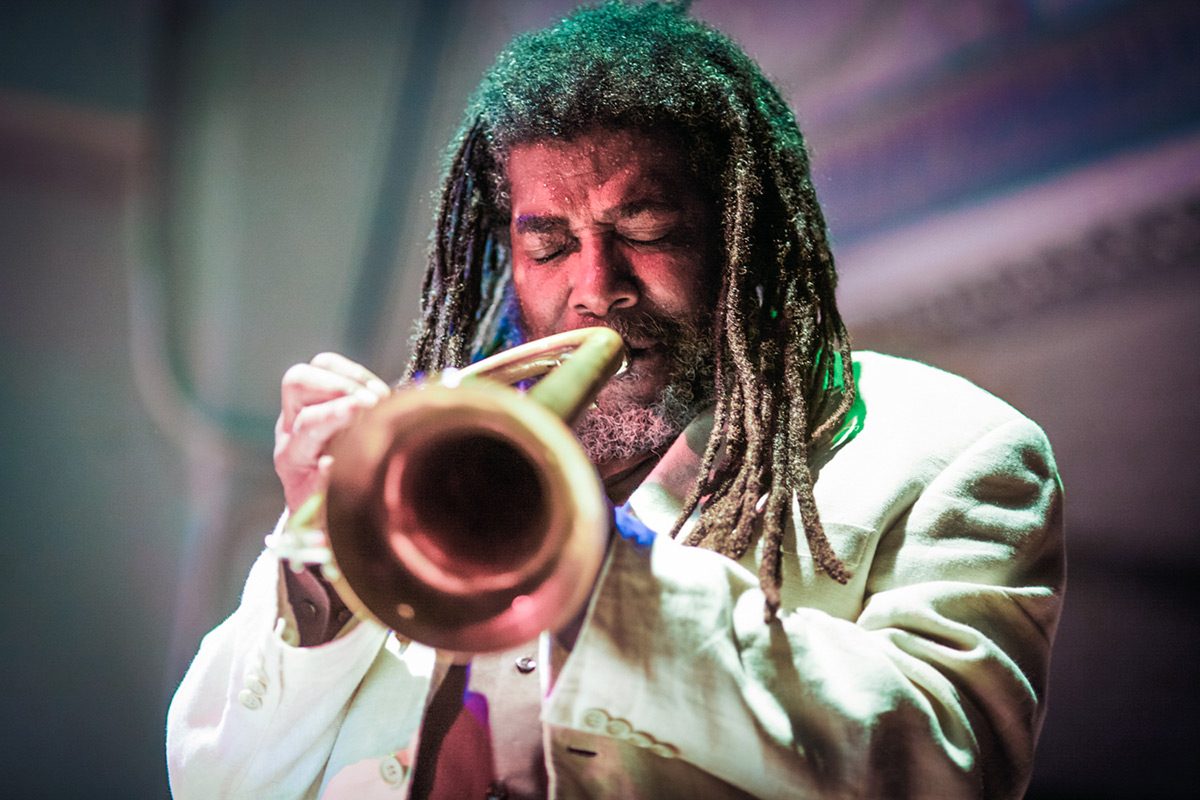
Wadada Leo Smith. Photo: Michael Jackson

Due to inclement weather impacting artist travel, we regret to announce that Emergency Eyewash ABC has been canceled. Ticket holders will be contacted directly with refund information.
Artist Carol Szymanski and poet and art critic Barry Schwabsky present Emergency Eyewash ABC, a live performance bringing together poetry, visual art, and music.
Moving between poetry, art, and music, the performance features a series of live readings from a new alphabet book for grown-ups written by 28 contemporary American poets alongside projections of Szymanski’s video fantasia on the alphabet and musical improvisation by legendary trumpeter and composer Wadada Leo Smith. Performing on Szymanski’s sculptural horns—playable brass instruments developed from the forms of an eccentric alphabet font of Szymanski’s design—Smith responds in real time to the spoken word and projected imagery.
Together, the artists transform the stage into a meeting place for poetry, imagery, sculpture, and music.
The limited-edition book Emergency Eyewash ABC will be available for purchase the night of the event.
Featured readers: Susan Bee, Charles Bernstein, Ama Birch, Ross Bleckner, Lee Ann Brown, Daniel Cabrera, Biddle Duke, Edwin Frank, Ed German, Andrea Glimcher, Joan Jonas, Sam Jones, Simone Kearney, Malerie Marder, Suzanne McClelland, Eileen Myles, Geoffrey O’Brien, Julie Patton, Veronica Gonzalez Peña, Sarah Riggs, Canning Robb, Robert Rubin, Barry Schwabsky, Eleni Sikelianos, Mónica de la Torre, Catherine Wagner, Matthew Ward, Cynthia Zarin. More to be announced.
Featured poets: Andrea Applebee, Molly Bendall, Jill Bialosky, Ama Birch, Charles Bernstein, Lee Ann Brown, Peter Cole, Edwin Frank, Judith Goldman, Richard Hell, Simone Kearney, Vincent Katz, Joyelle McSweeney, Eileen Myles, Geoffrey O’Brien, George Quasha, Julie Patton, Sarah Riggs, Aram Saroyan, Barry Schwabsky, Steven Seidenberg, Eleni Sikelianos, Eileen Tabios, Daniel Tiffany, Mónica de la Torre, Catherine Wagner, Matvei Yankelevich, and John Yau.
RUSH TICKETS
A limited number of $25 Rush tickets may be available for Guild Hall-produced programs, 20 minutes before start time, in person only. Guests are instructed to line up outside in the rush line for the potential release of tickets.
Carol Szymanski
Carol Szymanski’s language- based art spans many media, from sculpture and photography to video and performance, and often includes musical elements with poetic texts. She studied at the San Francisco Art Institute and the Whitney Museum Studio Program and her work has been exhibited internationally. She has become particularly known for a series of sculptures in the form of invented musical instruments, particularly brass horns, using an alphabetic font she designed. Recent exhibitions and performances including these instruments have been at e-flux Screening Room, Brooklyn, NY 2025 with Faye Victor, Sam Jones and Arda Cabaoglu; the Talea Ensemble 100th birthday celebration for Pierre Boulez at the Church of St Luke &St Matthew, Brooklyn, 2025; Torn Page, New York, 2025; Industry City as part of The Brooklyn Rail “Singing in Unison” exhibition series, 2022; Artist Studio Series curated by Jason Moran, with Jaime Branch, Veterans Hall, Park Avenue Armory, 2021; The Phonemophonic Alphabet Brass Band, Winter Garden, New York, New Sounds Live Series curated by John Schaefer, with Ben Neill and Pauline Oliveros, 2017; with Wadada Leo Smith and Betsy McClelland, The Drawing Center, New York, 1993; and with Dewey Redman at Pat Hearn Gallery, New York, 1993. She has been a recipient of numerous awards including the Rome Prize and a National Endowment for the Arts fellowship.
Barry Schwabsky
Barry Schwabsky has published six books of poetry including Feelings of And (Black Square Editions, 2022), Water from Another Source (Spuyten Duyvil 2023), and The Bone China Years (Black Square Editions, 2026) and has been a visiting artist at the Isabella Stewart Gardner Museum, Boston. Of his work the Canadian poet rob mclennan writes, “The poems sit as minor miracles, offering an enormous amount in small spaces, from sharp lines to sharp observations, all of which are offered in deceptively-plain but clearly a highly-crafted language.” He is also art critic for The Nation and an editor at Artforum, and is the author of The Perpetual Guest: Art in the Unfinished Present (Verso, 2016) and Words for Art: Criticism, History, Theory, Practice (Sternberg Press, 2013) as well as contributions to many books and catalogues on contemporary and modern art.
Wadada Leo Smith
Born on December 18, 1941 in Leland, Mississippi, Wadada Leo Smith began his musical journey steeped in the musical traditions of the South. He composed his first piece of music at the age of twelve, and at thirteen started performing with Delta Blues and other traditional bands. Smith received his formal musical education from his stepfather, composer/guitarist Alex “Little Bill” Wallace, one of the pioneers of electric guitar in Delta Blues. He was further educated through the U.S. Military band program at Fort Leonard Wood, Missouri (1963); Sherwood School of Music (1967-69); and Wesleyan University (1975-76). He has researched a variety of music cultures, including African, Japanese, Indonesian, European and American.
Smith was a finalist for the 2013 Pulitzer Prize in Music for Ten Freedom Summers, (Defining Moments in the History of the United States of America), a collection of compositions inspired by the civil rights movement and released as a 4-CD boxed set. Ten Freedom Summers has also been awarded a MAP Fund Award (2011), Chamber Music America New Works Grant (2010), National Endowment for the Arts Recording Grant (2010), Southwest Chamber Music commission with support from the James Irvine Foundation and Clarence E. Heller Charitable Foundation, and a John Simon Guggenheim Memorial Foundation Fellowship (2009-2010). Smith was named DownBeat Magazine’s Composer of the Year in 2013.
In 2016 Smith received a Doris Duke Artist Award and earned an honorary doctorate from CalArts, where he was also celebrated as Faculty Emeritus. In addition, he received the Hammer Museum’s 2016 Mohn Award for Career Achievement “honoring brilliance and resilience.” In 2018 he received the Religion and The Arts Award from the American Academy of Religion. In 2019 he received the UCLA Medal, the highest honor bestowed by the University of California, Los Angeles. United States Artists named Smith a 2021 USA Fellow, and he has been selected as a 2022 Mellon Arts & Practitioner Fellow at the Yale Center for the Study of Race, Indigeneity and Transnational Migration (RITM). Earlier in 2022, he also was commissioned by the LA Philharmonic to write the orchestral piece Gondwana: Earth, a Blue Sanctuary, Oceans, Seas, Lakes, Rivers, Springs and Lagoons; Paradise Gardens and Skies, as well as String Quartet #13, performed by the JACK Quartet
Photo: Jimy Katz
Emergency Eyewash
Emergency Eyewash is the conceptual “brand" or umbrella for collaborative projects by Carol Szymanski and Barry Schwabsky with many others in the fields of art, writing, design, sound, etc. A poetry anthology in the form of an alphabet book for grown-ups, Emergency Eyewash ABC grew at the intersection of Szymanski’s interest in using letter forms as building blocks for visual art and Schwabsky’s awareness of how poetry can activate even the smallest units of linguistic matter. They have invited a diverse group of outstanding American poets of different generations working in various modes to write poems responding to the letters of the alphabet—28 in all, adding the ampersand to the canonical 26 after learning that early American ABC books often included & after Z, and the period with the idea that the alphabet in itself constitutes a complete thought, a sort of sentence.
Sponsors
Performing Arts programs are supported by 2026 season sponsors Galia Meiri-Stawski and Axel Stawski, with additional lead support from Henry and Peggy Schleiff, The Melville Straus Family Endowment, Monica and Peter Tessler, and Vital Projects Fund.
Guild Hall’s Performing Arts programs are made possible by the New York State Council on the Arts with the support of the Office of the Governor and the New York State Legislature.
Music Programming is supported in part by The Ellen and James S. Marcus Endowment for Musical Programming, and the Anne Wolf Concert Fund.
Additional support provided by Friends of the Theater: Natascia Ayers, Bonnie and Joel Bergstein, Gene Bernstein and Kathy Walsh, Amy Cooney and Marty Feinman, John and Joan D’Addario, Lynn and Richard Feinson, Suzanne and John Golden, Hilarie and Mitchell Morgan, Steve and Susan Pesner and Peace, in memory of Michéle Pesner, whose entire life was devoted to all aspects of culture, The Schaffner Family Foundation, Lisa Schultz and Ezriel Kornel, Stacey and Oliver Stanton, Susi and Peter Wunsch, and Mrs. George Yates.