

A staged reading is a theatrical performance in which actors present a script with limited scenery, costumes, and other production elements. Rather than relying on elaborate sets or technical effects, the presentation places the emphasis on dialogue, character relationships, and the performers’ interpretation of the material.
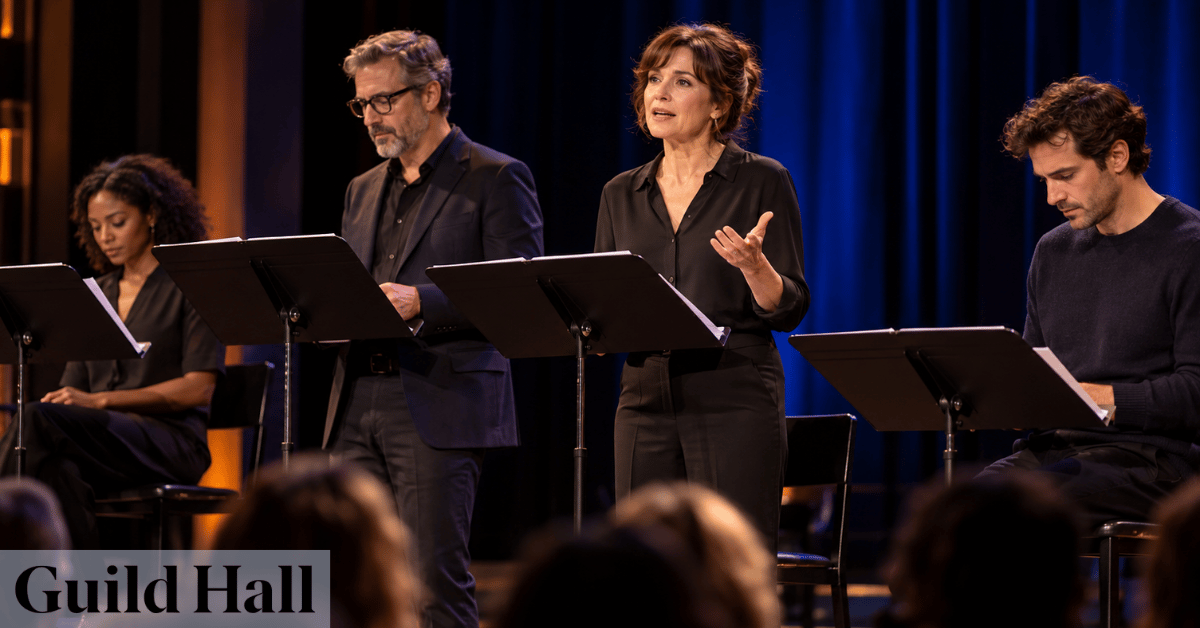
Actors often have scripts in hand or placed on music stands. Movement may be limited, and rehearsals are generally less extensive than those required for a fully staged play. Yet the simplicity of the format does not make it any less compelling. A well-performed reading can communicate humor, tension, and emotion through the actors’ voices and the way they respond to one another.
Staged readings have an important place in professional theater. Playwrights use them to hear new material performed, directors explore different approaches to dramatic storytelling, and actors discover characters without the demands of a complete production. Some readings are part of developing a play, while others are public performances intended to stand on their own.
At Guild Hall in East Hampton, staged readings have brought together established performers and emerging theatrical work, offering audiences an opportunity to experience storytelling in a format that places the script at the center.
What Is a Staged Reading in Theater?
In theater, a staged reading is a presentation of a dramatic text that uses fewer production elements than a conventional theatrical production. It can involve an original play, an established work, or a screenplay adapted for live presentation.
Unlike a fully staged production, where actors usually perform from memory and work within an established set, a reading allows the performers to keep the written text available. Depending on the director’s approach, actors may remain seated, stand at music stands, or move selectively around the performance space.
The amount of staging varies. Some readings are deliberately simple, with little more than chairs and scripts. Others incorporate lighting, basic blocking, or selected production elements to support the material.
The format also gives the audience a particular relationship with the work. Without detailed scenery to establish every location or costumes to define each character visually, listeners are invited to imagine more of the world themselves.
A change in vocal delivery can reveal a character’s intentions, while a carefully timed pause may create tension that would otherwise be communicated through physical action.
How Does a Staged Reading Work?
A staged reading begins with decisions about the script, the performers, and the purpose of the presentation. A playwright developing a new work may want to hear how the dialogue flows, while a director preparing an established piece might focus on exploring a particular interpretation.
The creative team determines how much rehearsal is appropriate and how the material will be presented. In some cases, actors have only a relatively short period to become familiar with the script. Other readings involve more preparation, particularly when the presentation includes movement or additional artistic elements.
During rehearsals, performers work on understanding their characters and establishing relationships. The director may guide the pacing of scenes, discuss motivations, or suggest how particular exchanges should unfold.
Because the actors commonly retain their scripts, memorization is not always necessary. This allows them to concentrate on the delivery of the material and their interaction with other performers.
The reading itself may take place before a small invited audience or as part of a public theatrical event. Stage directions that would normally be expressed through scenery or physical action may occasionally be read aloud, although the approach depends on the production.
What audiences see can therefore be quite different from one staged reading to another. Some presentations feel close to a conventional performance, while others deliberately expose the mechanics of theatrical storytelling.
Professional readings may also be subject to specific working arrangements. The Actors’ Equity Association Staged Reading Code outlines one framework under which union members may participate in certain developmental readings. Its restrictions apply to projects operating under that particular code, not to every staged reading presented by a professional theater.
The range of possible approaches is part of what makes the format useful. It can support an early draft of a play or provide the foundation for a carefully prepared public performance.
Why Staged Readings Matter in the Development of New Plays
One of the most valuable uses of a staged reading is helping playwrights understand how a work functions when it moves from the page into performance.
Writing dialogue and hearing it spoken are different experiences. A conversation that appears natural on paper may sound overly formal when actors perform it. A scene that seems brief during reading might take longer than anticipated, while a seemingly minor exchange can become emotionally significant through the performers’ interpretation.
A reading gives the playwright an opportunity to recognize these differences before committing to a full theatrical production.
It may reveal that certain conversations repeat information, that a character’s intentions are unclear, or that the pacing does not develop as expected. These discoveries can influence revisions and help the writer identify which aspects of the script already work effectively.
The actors contribute to that process through their individual interpretations. A performer might emphasize a particular line in a way that changes the relationship between two characters. Another may find humor or tension in an exchange that the playwright originally imagined differently.
The director helps connect these choices, shaping the rhythm of the performance and ensuring that the material develops coherently.
When readings are presented to audiences, reactions can offer additional insight. Laughter, silence, and attention reveal something about how the work is received, particularly when the presentation is followed by a discussion.
Not every audience response requires a revision, however. The purpose is not simply to determine whether people liked the work. It is to understand how the script communicates its ideas and how performers might develop them further.
These collaborative discoveries are an important part of theatrical development. They also connect to the wider creative process explored in Guild Hall’s article on the role of process in performing arts in the Hamptons.
Staged Reading vs. Full Theater Production
Although staged readings and fully staged theatrical productions both rely on acting and storytelling, they approach the material differently.
A full production usually involves an extended rehearsal process and collaboration among performers, directors, designers, technicians, and other creative professionals. Scenery, costumes, lighting, props, and sound may all contribute to the finished presentation.
A staged reading generally removes or reduces many of those elements, allowing greater emphasis to remain on the script and the actors.
The difference is particularly noticeable in the performers’ relationship with the text. In a conventional production, actors typically memorize their lines and develop detailed blocking, which establishes where and how they move throughout the performance.
During a staged reading, performers often retain their scripts and use more limited movement. This does not eliminate acting choices; it simply places those choices within a less elaborate production framework.
Rehearsal schedules also tend to differ. A fully staged play may require extensive preparation to integrate technical and artistic elements, while a reading can often be organized within a shorter period.
These distinctions are not absolute. Some fully staged productions intentionally use minimal scenery, and some readings feature sophisticated lighting or carefully planned movement.
The more meaningful difference is the degree to which the presentation develops the theatrical world beyond the written text.
The Difference Between a Table Read and a Staged Reading
The terms table read and staged reading are sometimes used interchangeably, but they often describe different approaches to working with a script.
A table read generally involves actors gathering to read a dramatic work aloud, frequently while seated. It may take place during early development or rehearsal and is commonly used in theater, film, and television.
The primary purpose is often to hear the entire script, evaluate dialogue, and understand how the story progresses when performed by different voices.
A staged reading usually takes that process further by introducing a more deliberate presentation.
Actors may stand, move between positions, or use limited blocking to establish relationships and dramatic action. The reading may be rehearsed specifically for an audience, although some staged readings remain private development sessions.
A theater workshop is another related format, but it describes a broader period of creative exploration rather than a single presentation. Workshops can involve rehearsals, script revisions, improvisation, movement exercises, and readings as artists develop a project.
Understanding these distinctions helps explain why a staged reading can serve different purposes.
Some readings are steps toward a future production. Others are special performances of existing material, with no intention of developing a fully staged version afterward.
A staged reading of a familiar screenplay, for example, can offer audiences a new interpretation of the characters without recreating the original film’s locations, cinematography, or editing.
In this context, the reading is not an unfinished film adaptation. It is a separate theatrical experience in which the performers’ interpretation becomes central.
Staged Readings at Guild Hall: Real Examples
Guild Hall’s history of theatrical programming includes staged readings that illustrate the flexibility of the format.
One example is Stan the Man, a dark comedy by Eugene Pack, presented at Guild Hall in July 2019. Directed by Josh Gladstone, the production featured professional performers including Alec Baldwin and Rob Morrow.
The reading explored the competitive relationships between businessmen attending a leadership seminar, using dialogue and character interaction to communicate the tensions within the story.
As a staged presentation of a theatrical work, Stan the Man offered audiences an opportunity to engage with the writing through the performances rather than through an elaborate production design.
A different example came on August 31, 2026, when The Center at West Park presented a staged reading of The Big Chill at Guild Hall.
The event featured the screenplay written by Lawrence Kasdan and Barbara Benedek, directed by David Saint. The announced ensemble included Marisa Tomei, Matthew Broderick, Ayo Edebiri, and other performers from theater, film, and television.
The presentation brought a familiar cinematic story into a live theatrical setting, where the dialogue and relationships between characters could be experienced through a new combination of performers.
The evening also included a talkback with the cast and creative team, giving audiences additional insight into the interpretation of the material.
Guild Hall’s article on the cast of The Big Chill provides further information about that presentation.
These two events demonstrate that staged readings are not limited to a single category of theatrical work. A reading may introduce contemporary dramatic writing, revisit an established screenplay, or create an opportunity for performers to collaborate on a special presentation.
Both reflect the importance of the script and the actors’ ability to transform written language into a shared experience.
Guild Hall’s performing arts programs continue to connect audiences with different forms of theatrical expression in East Hampton.
Planning Your Visit to Guild Hall
Guild Hall is located in East Hampton Village, making it a cultural destination for residents and visitors exploring Long Island’s East End.
Its Hilarie and Mitchell Morgan Theater hosts theater and other performing arts presentations, although the availability of staged readings depends on the current program.
Visitors interested in attending a reading should review the theater events calendar and check individual event descriptions. These provide information about the format of the presentation, scheduled time, participating performers, and ticket availability.
Guild Hall is located at:
Before attending, review your event’s start time, ticket information, seating arrangements, accessibility requirements, and any additional instructions.
Guild Hall provides parking behind the building on Pondview Lane, as well as along Main Street and James Lane. Visitors should allow sufficient time to find parking, particularly when attending scheduled performances.
Additional information is available through Guild Hall’s Plan Your Visit page.
Staged readings offer a distinctive way to experience theatrical storytelling, whether they introduce new writing or reinterpret an established work. At Guild Hall, this format has brought performers and audiences together through special presentations that reveal the creative possibilities of a script.
Explore upcoming theater events, discover Performing Arts at Guild Hall, or plan your visit to experience theater on Long Island’s East End.